
This is an old revision of the document!
**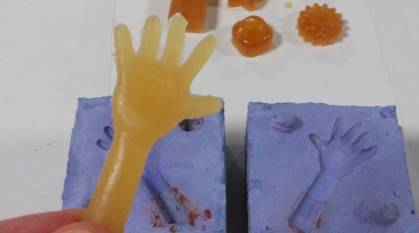 Bioplastic extracted from cactus **
The Mexixan stop-motion animation filmmakers Arturo Tornero Aceves (Monarca), and Nabí Orozco Torres (House of Memory) are working with chemical engineer Sandra Pascoe Ortiz to create a biodegradable alternative to plastic that can replace silicone in stop-motion animation production. As a research professor at the Universidad del Valle de Atemajac in Guadalajara, Sandra Pascoe Ortiz has been experimenting with some species of nopal, a native Mexican plant, to develop a non-toxic, renewable material made from cactus resin, which is extracted and then mixed with glycerin, proteins, and natural waxes. Unlike the production of traditional plastics, which are petroleum based, bioplastic extracted from cactus is renewable as well as carbon neutral.
Award
The Mexican Institute of Industrial Property awarded this new eco-friendly material with its first IMPI Mexican Invention Award. The goal was to develop a biodegradable alternative to plastic for common products: bags, single-use cutlery,packaging, coatings, and toys. This promising invention caught the attention of the filmmakers, who also teach at the university in Guadalajara. They started experimenting with this bioplastic. During the initial tests, the material shrank and turned into waste water. After conducting more than fifty experimental trials, the researchers figured out which ingredients to use to reduce shrinkage. The shrink ratio is about three to eight percent. Therefore, the final dimensions have to be upscaled by as much.
Properties
The cactus resin can be useful for stop-motion animation production because it can be easily cut with a knife, just as silicone, but it can also be stripped out of an armature. The armature can be recycled. All of the material disappears in a month’s time in water or compost. According to Arturo Tornero, it can even be eaten. ‘Cactus jelly’ tastes good, and it’s a little spicy.
Color
The team also experimented with color. The puppet was colored with curcuma and cacao. Their approach is to keep this product vegan so that it would be compostable. The original color resembled that of green tea. It’s possible to achieve a translucent look, but it always has a green cast. The team tried coloring it with pigments. It works with everything, and the colors are bright, but they want to try coloring it with organic pigments. There is still a lot of experimentation to do because the teams wants to develop a non-translucent substitute.
Development and test applications
As with any new material, the scientist and the filmmakers still need to invest time in its development and to test applications. This material is more complicated than inorganic chemical ones, because it has more limitations. This organic thermoplastic resin melts in water at 70 degrees Celsius. After the material is heated, it must be injected into a mold within fifteen minutes.
In order to avoid bubbles, the material, just like silicone, can be placed in a vacuum chamber. After two hours of refrigeration, it stabilizes. This material can also be used in a 3D printer, but this requires another operation. This material takes three times longer than silicone to work with. But once that is done, it can be reused.
Source
Since the source material is cactus, which grows on nearby plantations, it is sustainable and has a locally sourced supply chain. It works for small productions, but there are limitations for its use in an industrial process. If a film company were to order fifty kilograms, we wouldn’t be able to fulfill the order because we don’t have the infrastructure to produce on that scale. So far, there is no investment in its development because producers are still skeptical of this new material, largely on account of its limitations. Nevertheless, scientist Sandra Pascoe, Ortiz, the filmmakers, and the university applied for a patent.